This is Part 4 of a 10-part series exploring questions in Scripture and what they reveal about building resilient relationships with God and others.
What if one of the best tools for passing on your faith is already sitting on your bookshelf? God seemed to think so. When He wanted His people to remember what He had done, He didn’t start with a lecture. He gave them stones of remembrance, a meal, and a reason for their children to ask, ‘What does this mean?
In Part 1, we discovered that Scripture holds far more question marks than exclamation points. Part 2 gave us five guidelines for reading the Bible with a questioning heart. Then in Part 3, we went back to the garden and heard the first questions ever recorded in Scripture. This time, we follow the questions in the Bible to Egypt and the nation of Israel, and see how God uses questions and stones of remembrance together to pass faith from one generation to the next.
A Story on a Shelf

Have you ever held an old family photograph, turned it over in your hands, and asked, “Who is this?”
Or maybe your child once pointed to a strange object on your bookshelf and asked, “What’s that for?”
I have a little canoe figurine sitting on my bookshelf. It might look like a pretty decoration, but it’s an object my husband Peter gave me when he asked me to marry him, symbolizing his desire and request that we would be in the same boat together, rowing together in the river of life. So what looks like a pretty little figurine on a bookshelf becomes a story of romance, legacy, and interest when I share it with my kids.
Moments like these are sacred opportunities: questions that open the door to deeper stories, richer meaning, and lasting legacy.
In this post, we’re going to walk through a few key moments in Israel’s history, moments when God designed stones of remembrance, visible reminders that invited curiosity. He knew that when His people remembered His works and retold His story, their faith would grow strong and be passed on.
So whether you’re parenting, mentoring, or simply shaping the spiritual culture of your home or community, you’re involved in discipleship, and this post is for you.
A Cry and a Covenant
Let’s begin not in Genesis this time, but in Egypt.
In Exodus 2:23-25, we read that the Israelites groaned under slavery:
Their cry for rescue from slavery came up to God. And God heard their groaning, and God remembered his covenant with Abraham, with Isaac, and with Jacob. God saw the people of Israel—and God knew.
Their cry wasn’t polished or eloquent. It was desperate. But it reached heaven. And that raw, guttural cry became the spark of their deliverance.
God responded not only by sending Moses, but by setting in motion a story of redemption filled with symbol, timing, and design, a story meant to be told again and again.
Fast forward to the night before their escape from slavery in Egypt. God gives precise instructions for the first Passover: how to mark their doors, how to prepare the meal, what to wear. But right in the middle of the logistics, He embeds a teaching strategy.
When Your Children Ask: God Designs for Curiosity
Here’s what God says in Exodus 12:25-27:
And when you come to the land that the Lord will give you, as he has promised, you shall keep this service. And when your children say to you, “What do you mean by this service?” you shall say, “It is the sacrifice of the Lord’s Passover, for he passed over the houses of the people of Israel in Egypt, when he struck the Egyptians but spared our houses.” And the people bowed their heads and worshiped.
Did you catch that? “When your children ask…”
The Passover meal wasn’t just a ritual. It was a relational moment designed to raise questions. God built curiosity into the very structure of worship.
The table became a classroom. The meal became a memory.
The Four Questions at the Passover Table
That one phrase, “When your children ask,” became a foundation of Jewish faith formation. In every generation, children at the Passover table still ask what’s called the Mah Nishtanah, the Four Questions: “Why is this night different from all other nights?”
Those questions are simple, but they represent something profound: God made curiosity part of faith formation. Instead of monologues, He designed dialogues. Instead of rote recitation, He chose tangible experiences (unleavened bread, bitter herbs, reclining postures) to invite wonder.
Questions create space for discovery. That’s exactly what we see here: God using the natural curiosity of children to transmit eternal truth.
Stones of Remembrance at the Jordan River

Now fast-forward to Joshua 4. The Israelites have crossed the Jordan River on dry ground, a second miracle of deliverance. God tells Joshua to choose twelve men, one from each tribe, and Joshua passes along the instructions:
Take up each of you a stone upon his shoulder, according to the number of the tribes of the people of Israel, that this may be a sign among you. When your children ask in time to come, “What do those stones mean to you?” then you shall tell them that the waters of the Jordan were cut off before the ark of the covenant of the Lord. When it passed over the Jordan, the waters of the Jordan were cut off. So these stones shall be to the people of Israel a memorial forever. (emphasis added)
Again, that divine pattern: a visible reminder, a curious child, a sacred story.
God could have required a formal creed or a detailed lecture. Instead, He asked His people to stack stones of remembrance.
Because God knows how memory and meaning work. He created us to remember through senses and stories. Those stones weren’t just rocks. They were conversation starters. They connected future generations to past faithfulness.
Every one of those stones of remembrance whispered, “God was here. God acted. God saved.”
Your Modern Stones of Remembrance

We may not have a pile of Jordan River rocks in our living rooms, but I bet you have something close.
Look around your space: A valued photo, a dog-eared Bible, an antique camera, a travel keepsake, a handwritten recipe, a piece of artwork, a9 cowrie shell.
Every object holds a story.
Now, I’m not suggesting that you hold on to clutter just because it might be a great conversation starter someday. I’m suggesting we can curate wise, intentional moments, even through the memorials we feature in our homes and in our lives.
Your stories can become stones of remembrance.
Here’s a simple challenge for this week:
- Identify a “stone.” Choose one item that carries meaning, a reminder of God’s faithfulness or your family’s story.
- Craft one question. Imagine someone pointing to it and asking, “What’s that?” or “Why do you keep that?” Be ready with a story. It might sound like:
- “Let me tell you about the time God showed up…”
- “This reminds me of a promise we’re still holding onto…”
- “This helps us remember who we are and where we’ve come from.”
That’s how faith travels: from heart to heart, through real stories, in response to genuine curiosity.
And if you’re a parent, grandparent, mentor, or small-group leader, this practice is gold. Create an environment where asking is safe and answering is relational.
You don’t need a theology degree (I’m really glad for that!). You just need presence and honesty.
Because the next time someone notices that object and asks about it, it’s not just small talk. It’s sacred ground.
Questions That Build Legacy
God didn’t just command His people to remember. He designed for curiosity to keep memory alive.
When a child asks “Why?” or a friend wonders “How did you know God was real?”, that’s a doorway. A chance to tell the story again.
Faith that is remembered is faith that is repeated. And faith that is questioned is faith that grows strong.
So this week, over dinner or coffee or LEGO building or a board game, try one family question:
- “What object that you can see right now reminds you of God’s faithfulness?”
- “Does anyone remember the story behind [this object]?”
- “What do you think God is teaching us right now?”
Just one question over one meal. That’s how stories start. If you’d like more ideas, you can grab free conversation starters organized by life stage.
Stump the Pastor: Everything Points to the Creator
God has always used tangible reminders (stones, meals, altars) to help His people remember His faithfulness. And sometimes, those reminders show up in the most unexpected places, like a Sunday morning children’s service.
At our church, whenever children join the main service, we have a moment everyone looks forward to called “Stump the Pastor.”
Upbeat music starts playing, and the kids come jumping onto the stage. One of them is holding a paper bag with something hidden inside, an object the pastor has never seen before.
The pastor reaches in, the whole congregation watching, wondering what he’ll find this time. Sometimes it’s a toy figurine. Other times, a shoelace, a Rubik’s cube, or a pacifier. I’ve seen a stuffed animal, a keychain, even a chocolate bar.
Then comes the challenge: right there, in real time, the pastor has to take that random object and connect it to a truth about God.
And you know what? Every single time, he does.
What “Stump the Pastor” Taught Me
It’s taught me something I can’t forget: there is no part of creation that doesn’t point back to its Creator. As Psalm 19 says, “The heavens declare the glory of God, and the sky above proclaims his handiwork.”
So take a cue from “Stump the Pastor,” and let it change how you see your everyday surroundings. Now, when I pick up a misplaced toy, a mug from a favorite trip, or a cozy throw blanket, even, I can pause and ask: How does this object remind me of Jesus?
Because when we slow down long enough to ask that question, the ordinary becomes extraordinary.
Our shelves and drawers and homes are full of modern stones of remembrance: everyday objects that whisper, “God was faithful here.”
Try It This Week: Pick Up One Object
So here’s your gentle challenge this week: Pick up one object nearby. It could be something that sits unnoticed on a shelf or tucked away in a drawer. Hold it in your hand. Think. Pray.
Then ask, “What truth does this remind me of?” Maybe it’s:
- “This reminds me that God provides when I least expect it.”
- “It helps me remember that He restores what’s broken.”
- “This shows me that God delights in beauty and detail.”
And then, tell someone that story. At dinner. On a walk. In the carpool line.
We’ve discovered in our home that the items around us tell stories of God’s faithfulness, if we take time to tell them. And as our children hear and join those stories, they’re learning that faith and family flourish through curiosity and conversation.
You Are a Living Memorial
You and I are living memorials. Every answered prayer, every redemption story, every “remember when God…” moment: these are the stones of remembrance we stack for those who follow us.
When we tell those stories, we don’t just recall the past. We reaffirm God’s character in the present.
So let’s live expectantly, believing that questions will come, and being ready with stories that point to the God who saves, provides, and redeems.
Every question is an invitation, and every story you tell becomes a stone of remembrance. Each moment of wonder points back to the God who hears, delivers, and says, “When your children ask… you shall tell them.”
If this post sparked a memory or inspired a “stone” of your own, I’d love to hear about it. Share it in the comments below or tag me on Instagram @mandy_pallock.
Reflection Questions
- What object in your home carries a story of God’s faithfulness? Who could you tell that story to this week?
- What is one “stone” in your life that you could be ready to talk about? If someone asked, “Why do you keep that?”, how would you answer?
- Who in your life needs to hear a story of God’s faithfulness? What is one family question you could ask over your next meal?
Reflect on Scripture
- Matthew 6 contains eight questions: five that Jesus asks directly and three worries He quotes in verse 31 (“What shall we eat?” “What shall we drink?” “What shall we wear?”). Read the chapter for yourself and listen for both the questions and the everyday memorials. Jesus uses birds, clothes, and food to show God’s goodness and faithfulness, drawing our hearts back to trust in the Father.
- Which question in this chapter do you most need to hear today?
This post is adapted from #74 of the podcast, Presently Engaged with Mandy Pallock. Watch the full episode here if you prefer video.
The Questions in Scripture Series
- Part 1 of 10: Why Questions Matter: The Power of Curiosity in Your Faith
- Part 2 of 10: How to Read the Bible with a Questioning Heart
- Part 3 of 10: When a Question Broke the World
- Part 4 of 10: Stones of Remembrance: How Stories and Questions Shape Faith
Want to Go Deeper?
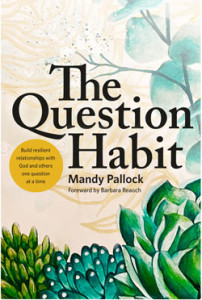
This series is based on insights from The Question Habit: The Art of Building Resilient Relationships with God and Others by Mandy Pallock. Visit thequestionhabit.com for more.
Asking questions and listening well can take every relationship deeper!
By Mandy Pallock